
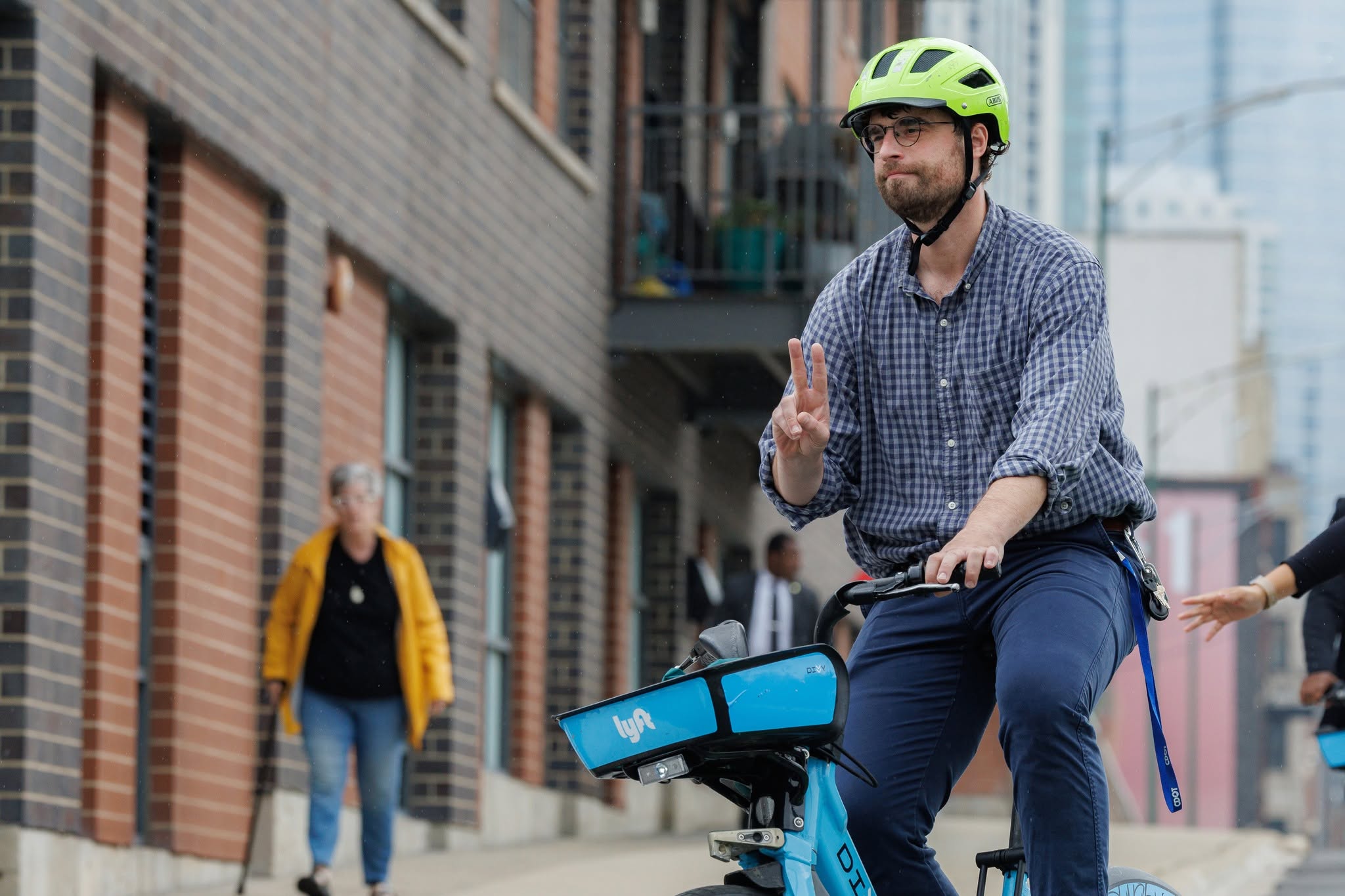
According to witness accounts and reports, O’Neil was traveling in the marked bike lane on the 3200 block of South Halsted Street when the driver of a parked vehicle suddenly opened a door into the bike lane. O’Neil attempted to avoid the door but struck it and was thrown into the roadway, where he was subsequently struck by a passing semi-truck.
The loss is especially devastating because Riley O’Neil was not only an experienced cyclist, but a transportation professional whose life's work focused on improving bicycle infrastructure and safety throughout Chicago. O’Neil served on CDOT’s Complete Streets team and previously led the City’s bicycle parking program, helping expand bicycle accessibility throughout Chicago. Colleagues described him as a passionate advocate who worked tirelessly to make Chicago safer for everyone who uses its streets. The fact that this crash occurred not only in a marked and dedicated bike lane, but the Chicago Police Department's 9th District police station is located next to the crash scene.
The Danger of Dooring in Chicago
Dooring crashes remain one of the most serious threats facing Chicago bicyclists. A "dooring" occurs when the occupant of a parked vehicle opens a door into the path of a bicyclist without first checking whether it is safe to do so. For bicyclists traveling alongside parked vehicles, a suddenly opened door can leave virtually no time to react. Riders may strike the door directly or be forced into moving traffic while attempting to avoid it.
Illinois law and Chicago municipal ordinances clearly prohibit this conduct. The Chicago Police Department issued multiple citations to the motorist who opened the car door into the path of Riley O'Neil.
Section 9-80-035 of the Chicago Municipal Code provides:
"No person shall open the door of a vehicle on the side available to moving traffic unless and until it is reasonably safe to do so and can be done without interfering with the movement."
The Duty of Due Care: A 45-Year-Old Law Designed to Protect Illinois Bicyclists
As bicycle ridership continues to grow throughout Chicago and across Illinois, much attention has been focused on new legislation designed to improve safety for people riding bicycles. Protected bike lanes, safer intersection designs, lower speed limits, and enhanced traffic enforcement have all become part of the conversation.
What many people do not realize, however, is that one of the strongest legal protections for bicyclists in Illinois is not new at all. In fact, one of the most explicit laws protecting bicyclists has been on the books for nearly 45 years.
Illinois Recognized the Need to Protect Bicyclists in 1981
On August 12, 1981, Public Act 82-132 became law when it amended the Illinois Vehicle Code to expressly require motorists to exercise caution around people riding bicycles.
The law provides:
"Every driver of a vehicle shall exercise due care to avoid colliding with any person operating a bicycle or other device propelled by human power…and shall exercise proper precaution upon observing any child or any obviously confused, incapacitated or intoxicated person."
This language was significant because it placed an affirmative legal duty on motorists. The law did not merely suggest that drivers be careful around bicyclists. It required them to exercise "due care." Today, this protection is codified in Section 11-1003.1 of the Illinois Vehicle Code.
Chicago Adopted the Same Protection for Bicyclists
Nearly a decade later, the City of Chicago reinforced this same principle by incorporating similar language into its Municipal Code.
Section 9-40-160 of the Chicago Municipal Code states:
"Every driver of a vehicle shall exercise due care to avoid colliding with any pedestrian, or any person operating a bicycle or other device propelled."
Truck Drivers Are Also Regulated By Federal Law
The second vehicle involved in the crash was a semi-truck travelling on Halsted Street. While the actions of the driver that doored the bicyclist have been the focus, questions remain regarding the interaction between the bicyclist and the semi-truck prior to the collision. The driver of this second vehicle also had the duties to exercise due care around the bicyclist and to keep a proper lookout for all traffic on Halsted Street, including bicycles in the Halsted Street bike lane.
“Every commercial motor vehicle must be operated in accordance with the laws, ordinances, and regulations of the jurisdiction in which it is being operated. However, if a regulation of the Federal Motor Carrier Safety Administration imposes a higher standard of care than that law, ordinance or regulation, the Federal Motor Carrier Safety Administration regulation must be complied with.”

